Vang Vieng, over 8 hours away from Phonsaven by bus and full of falang. These tourists are here to party, and party hard. I find it amusing that this entails getting as drunk as possible, often as naked as possible, either in public (for the girls) or probably private for the guys. Having spent about an hour or so with some Lao people downstairs, which was interesting but sometimes slightly disturbing as a few of the men seemed to think that I was interested in having sex with them, I decided to go with some other travelers to a traveler bar. There were bright lights, western music (MGMT and some other hits hit the soundwaves) and lots of foreigners getting drunk much as they would at home, expect here there are less boundaries. Women take part in wet t-shirt competitions as though it defends the honour of their family. Funnily enough, if that was the motivation you'd give them they probably wouldn't do it. I wonder what it is about us westerners that we believe that the more liberated we are, the more we are willing to let go of our physical selves, not in denunciation or control, but to revel in the letting go.
I don't mean that there is anything inherently wrong with this, just that we, in general, seem to view this as a freedom when in fact it is not. In my mind, it is more that we become slave to it than master. Yes, getting naked in front of a load of people and giving yourself to whomever you choose (oh and what a choice hahaha) may be the most liberating experience of your life, but what have you freed from within you?
I am not sure that what I want to say is really coming out. I've had a lot of Beer Laos and some Lao-Lao (potent rice whisky) on top of a +6 hour bus journey which I had to wait over 6 hours for. All I really want is to talk to people I know, have fun with friends then cuddle up in bed with my boyfriend. I hate that people judge me, I hate that they think I am judging them. Sometimes I wonder if we all suffer from some sort of inbuilt guilt complex where we see others but feel bad for having an opinion of them as this then involves some sort of judgment, however surface-level that may be. The thing is, a component of human nature is to evaluate ourselves against what we are not in order to know what we are. I know that these people around me are a lot younger than me and having fun in the way they know how and are comfortable with, I wonder, for a moment, if this is the evolution of the species; a road towards having less discernible differences so we all become very similar on the outside and more able to communicate from deeper within,
Now, I know, this is all sounding a bit sci-fi. So I stop.
I want to be held. I would like to know it is okay to be like me..sometimes, in this sea of difference, I seek some sort of reassurance to stop myself feeling like I might go mad. Rarely you meet people who feel the same. Like gems amidst the mud and dust and straw of everything else, they stand out as something different. I wonder if I shine like them or look like some odd thing left behind from some far away place. This is my big-headedness coming out, but also this awareness that (maybe in large part due to age difference, something I never really thought mattered that much) I AM different.
In my small concrete room with fan whirring I look up at lumpy tangerine-blancmange ceiling, listen to the whirrrr of the fan and just want to get out of here. The travelers' idea of fun is to get drunk with a bunch of other travelers, possibly take your clothes off and act out all those same insecurities and power games as you would at home. What do you learn, what do you see that is different from your country? Maybe you feel more free as your friends are not there to see, record and maybe judge. Maybe you think this is what you are meant to do. And anyway, in another 5 years, will you really give a shit about the video of you dancing topless next to some random man who wants to get in your pants?
Probably not.
I feel like I come from another planet.
Saturday, May 9, 2009


UXO and Plain of Jars
Phonsaven is reminiscent of a film set. Not in its grandeur (it doesn't have any) but in its sense semi-desolation – that air of having been forgot. The main street makes me feel like I am in a western; the dust, the straight, straight road lined with concrete shops and restaurants advertising the sale of the same things with sun-faded images. The products look like they're straight from a 1970s reconstruction project. I opt to stay at Kong Keo guesthouse and it turns out to be cheaper than most other options (always a bonus). Right by the old airfield it is atmospheric with old ordnance (more on that later) but rather empty, and my cell-like room seems damp and musty. Whatever. I am only really here for one thing – the Plain of Jars. Plains would be more accurate. 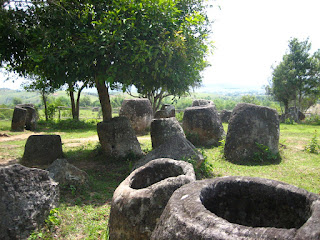 Dating from possibly over 2000 years ago, there are apparently 18 sites with these huge stone jars scattered around the landscape like guests mingling at a wedding reception. No-one knows why they're there or what they were for, but they are rather beautiful and, obviously, intriguing. The group I am with visit the 3 main sites of the Phonsaven area. Driving through the Laos countryside I am struck by how this nation is so much more of a developing one than Thailand, Malaysia and even Indonesia. This also means that things are so much more natural – as in linked to the earth and the reality of living with it. It is far clearer here how powerful a force nature is...makes me wonder how, in the Western world, we think we've tamed or mastered it with technological advances and lots of concrete and steel. I don't know if we're mistaken or not, but I do think we've lost a vital connection to where we come from, what we're a part of. At each Jars site is an advisory board telling visitors to stay within the white coloured markers – this is not to stop you walking on the grass but an important security issue. Unexploded ordnance (UXO) remains a massive problem in Laos, particularly in Xieng Khuang Province. Laos...unexploded ordnance? What? My ignorance was total until I read the Laos section of my guidebook and followed their advice to go to the MAG (Mines Advisory Group) centre in Phonsaven. Basically, between 1964 and 1973 the USA bombed Laos, flying 580,344 missions and dropping 2 million tonnes of bombs. Which happened to be in complete contravention of the Geneva convention signed shortly before the year this Secret War started. Scared of communism in S.E. Asia, these bombings were generally untargeted and many involved what are locally known as 'bombies', cluster-bombs: a large casing housing hundreds of smaller bombs generally full of ball-bearings that explode in many directions on impact. A bit like blowing your nose, these scatter across the green landscape....as 30% of them did not explode, they constitute, 30 years on, a deathly legacy of an 'illegal' war (what war is legal?). The thought that kept going through my head at the MAG centre, looking at war remnants and learning about their impact on the people of Laos was that someone made these weapons. Companies made profit on these items whose sole purpose is to kill and injure civilians. Cluster bombs do not pierce tanks. Do not do any great damage to buildings (especially if they're fortified ones). The question I did not ask myself earlier about why Laos is still obviously a developing country has been answered. These people, especially in rural areas, risk death and severe injuries on a regular basis to do the daily activities required to make a living. Tilling the fields, staking a buffalo to pasture, getting scrap metal to sell, playing in the fields as children...all could end in a loud bang and loss of life, limbs, sight. Even road building, or indeed, any kind of construction is a far lengthier and expensive process because of the huge amounts of UXO covering vast swathes of the country. Makes you think, doesn't it?
 Dating from possibly over 2000 years ago, there are apparently 18 sites with these huge stone jars scattered around the landscape like guests mingling at a wedding reception. No-one knows why they're there or what they were for, but they are rather beautiful and, obviously, intriguing. The group I am with visit the 3 main sites of the Phonsaven area. Driving through the Laos countryside I am struck by how this nation is so much more of a developing one than Thailand, Malaysia and even Indonesia. This also means that things are so much more natural – as in linked to the earth and the reality of living with it. It is far clearer here how powerful a force nature is...makes me wonder how, in the Western world, we think we've tamed or mastered it with technological advances and lots of concrete and steel. I don't know if we're mistaken or not, but I do think we've lost a vital connection to where we come from, what we're a part of. At each Jars site is an advisory board telling visitors to stay within the white coloured markers – this is not to stop you walking on the grass but an important security issue. Unexploded ordnance (UXO) remains a massive problem in Laos, particularly in Xieng Khuang Province. Laos...unexploded ordnance? What? My ignorance was total until I read the Laos section of my guidebook and followed their advice to go to the MAG (Mines Advisory Group) centre in Phonsaven. Basically, between 1964 and 1973 the USA bombed Laos, flying 580,344 missions and dropping 2 million tonnes of bombs. Which happened to be in complete contravention of the Geneva convention signed shortly before the year this Secret War started. Scared of communism in S.E. Asia, these bombings were generally untargeted and many involved what are locally known as 'bombies', cluster-bombs: a large casing housing hundreds of smaller bombs generally full of ball-bearings that explode in many directions on impact. A bit like blowing your nose, these scatter across the green landscape....as 30% of them did not explode, they constitute, 30 years on, a deathly legacy of an 'illegal' war (what war is legal?). The thought that kept going through my head at the MAG centre, looking at war remnants and learning about their impact on the people of Laos was that someone made these weapons. Companies made profit on these items whose sole purpose is to kill and injure civilians. Cluster bombs do not pierce tanks. Do not do any great damage to buildings (especially if they're fortified ones). The question I did not ask myself earlier about why Laos is still obviously a developing country has been answered. These people, especially in rural areas, risk death and severe injuries on a regular basis to do the daily activities required to make a living. Tilling the fields, staking a buffalo to pasture, getting scrap metal to sell, playing in the fields as children...all could end in a loud bang and loss of life, limbs, sight. Even road building, or indeed, any kind of construction is a far lengthier and expensive process because of the huge amounts of UXO covering vast swathes of the country. Makes you think, doesn't it?
Road to Phonsaven
I don't know why it's so funny to watch people try to recline their seats on a bus, but to me, after only a few hours sleep, it is. After nearly getting in a completely different tuk-tuk for fear of missing the bus (and mistaking the driver for another...at some point it's true that all Asians look the same to Westerners, though I'm sure they say the same about us) I am now on the A/C 8 hour bus journey to the capital of Xiang Khuang Province. Bus travel in Asia is weird. You can buy your ticket in town (in this instance I got quoted between 80,000 – 120,000 kip) or just get it at the station for 75,000 kip. You put your bag in the under-bus storage compartment (or someone else rams it in there) then go off in search of snackage an a bathroom; there is an eight hour bus journey ahead of you after all.
Upon arriving back at the bus, you see all the bags being taken out of the hold and carried on to the bus (usually to prime seats for some unknown reason). Why you might ask? A valid question. In the case of this bus, its because a whole other kind of cargo is being loaded in there. Coal. Bags and bags of it that sometimes split open and the pieces diligently retrieved and shoved back in the rent cloth. Is this a needed product that one passenger is taking home with him? Could it be a gift for the in-laws? A bribe to an official or land owner? Or, more simply yet less interesting, does the 1 per day bus act as a cargo container too, carrying produce of different kinds to other towns? My mind reeled at the possibilities.
Also, you may not need your iPod. Many buses come kitted out, not with anything as practical as a toilet but with speakers and even TV screens – these are not for safety announcements dear friends, but for movies (anything from knock-off box office DVDs to local karaoke-style music videos) or, in the case of this particular bus, what I can only presume from the crackling in and out and almost blissful moments of silence, is the radio. At least the music itself, though often blaring (note to self: always pay attention to speaker placement when 'choosing' seat) is not too terrible. It does set the mood as the bus rolls slowly down this now sealed road past green hills, numerous trees and wood/wicker walled houses.
One more thing before I try to catch up on the sleep lost last night. Since Fiji, all countries I've been to have driven on the left. In Laos they drive on the right. I have this feeling that in Vietnam they drive on whichever side of the road they feel like, but I'm interested to find out how it is in Cambodia and Japan.
Luang Prabang, Laos: Stop 10
The small plane was low on the ground with the propellers higher than the windows. This Aerospatiale Alenia ATR 72 flew over fields and through clouds before lush green hills were below us. Landing at Luang Prabang is beautiful – hills and mountains dot the landscape and the airport itself is tiny, one runway and one building (much like Fernando de Noronha's diminutive airport). Don't expect to find a duty-free here!
Most nationalities are required to have a visa to enter Laos and, contrary to the guidebook, the price varies depending on where you're from. The lowest is US$30 for several European and some South American countries. Americans and British pay US$35. For some reason the Canadians are left with a hefty price tag of US$42: the most expensive of the lot! Not sure what Canada's done to the Laos people or government, but I'm happy I don't have my blue passport yet.
This city's name sounds like a bell, ringing in a magical way. Luang Prabang...it is beautiful, romantic and easy to explore. The Mekong flows to one side of it and a river to the other, the city nestled in between like a happy dog sleeping in its bed. The atmosphere is friendly too, and there are a lot of travelers but it doesn't have the backpacker drunken vibe that lots of other places I've been have. At the airport I met Tom, an American geologist who was in Bangkok on business and came to Laos for a few days. We met up for beer one night and talked about a whole bunch of things, then at 11pm the lights went out and everyone was told they had to leave. It happens that Luang Prabang has a curfew! Everyone has to be home by midnight...quite a surprise!
My second day I didn't feel too well – feverish and muscle aches so I didn't get to see many of the sights I'd wanted...but it was great to relax and I plan to be back!
Wednesday, May 6, 2009
Notes on Wat Pho (Bangkok)
Intricate roofs, impressive tiling and the constant sound of devotional coins being evenly distributed into bowls... Wat Pho is famous for its reclining Buddha (depicts the moment of his ascension to nirvana) and I come, like all the other tourists, take some photos... he is impressive after all. At 46 metres long and 15 high, this is one big dude. Supine, eyes half-closed in what one can only imagine is bliss, I wonder what he thinks of all these people with lenses trying in vain to capture the majesty before them.

The wat complex stretches out under the sweat-inducing sun. There are numerous ornate chedi's and hundreds of smaller, golden Buddha images locked behind glass doors. I imagine them getting loose and running amok in the city, marching like an army down the streets, clanking a little like Tik-Tok in the Return to Oz. Their peaceful looks, multiplied many times becomes, after a while, a little alarming. They are watching you... Surprisingly some of them have belly buttons.
Every time I see a Western man (particularly an older one) with a young Thai woman my immediate thought is whether this is a 'business' arrangement. Also, at such a tourist attraction as this, how many other men must she have taken here? Must get bored of it after a while – or is this more of a cultural exchange than other parts of their relationship?
Sweat beading on my face (funny that a face can perspire so much), its time to move on. Back down the river for some lunch and an ice cold drink.
Chiang Mai
Northern Thailand: a whole other world yet still a traveler's paradise of a slightly different sort. There are lots of hill tribes that can be visited on various treks, the usual plethora of wats and a range of outdoor activities, not to mention massage, cooking and meditation courses on offer. With so much to do, what would I choose to occupy my 3 days here with? Not long enough to really go on a proper trek and with adventurous activities awaiting in Laos with (hopefully) less tourists, I decide to enjoy the city and some of the surrounding area on the back of a scooter. And take advantage of cheap but quality dental care to have my teeth lightened by cold laser. Yes, I am now a health care tourist...
There are a few wats outside Chiang Mai, the most impressive being Wat Phra That Doi Suthep, perched on a hilltop quite far from the sweat and dust of the city. On the journey there I also took in Wat U Mong near Chiang Mai University. Set in woods, there must be a meditation school here as many of the oddly utilitarian-looking sparse concrete buildings are signed as “Men's Quarters”, “Women's Quarters” etc. However I didn't come here for spiritual enlightenment, goddammit, I came here to see the underground tunnels created so monks could wander around and find that elusive nirvana themselves without straying too far from the Wat.
Following a path of Buddhist sayings written on sturdy plastic and attached to trees (my favourite is shown above) I came to the tunnels. I'm not sure quite why I was expecting a developed, labyrinthine system of them but there were three. All leading to the same place (unless you count the cleaners' storage cubby-cave as a destination). Next stop – a waterfall! There is an odd fascination with waterfalls all over the world and I still have to get to the bottom of it. In some hotter countries I think some of the appeal must be this cool, clean (?) water coursing down into pools, not to mention its cleansing properties and the sheer power of it. This was quite a nice one, running over rocks and the whole thing was part of an outer city park, lots of Thais were there having picnics, children running around.
On the way out Edwin & I passed stalls selling S.E. Asian snack food: deep-fried insects. Having once chowed down on these Alienesque creatures at Montreal's Insectarium, I shoved a crispy worm-like one in my mouth. Oh yummy. I think the stall owner was quite happy that these falang wanted to try his wares and proceeded to hand me a silk-worm (tasted like cheese) then a...huge grasshopper. Fried to brown perfection its big head and long, bent legs were too much for me; although to his credit Edwin munched down and declared it to be “delicious”, “the best yet”. Big fat locusts and smaller beetley type delicacies glistened in their oily fried glory.
That night we reunited with Joe who had stayed in Bangkok and a bunch of us went out to eat, drink and celebrate Edwin's birthday. The buckets, literally a small bucket of alcohol, usually cocktails, abounded and the fun began. Until the next day, when I had to get yet another night bus, this time to Bangkok prior to flying out to Laos. Although I would have loved to have stayed longer with my traveling friends and see more of the area, I just have to think to myself that there will be a next time.
There are a few wats outside Chiang Mai, the most impressive being Wat Phra That Doi Suthep, perched on a hilltop quite far from the sweat and dust of the city. On the journey there I also took in Wat U Mong near Chiang Mai University. Set in woods, there must be a meditation school here as many of the oddly utilitarian-looking sparse concrete buildings are signed as “Men's Quarters”, “Women's Quarters” etc. However I didn't come here for spiritual enlightenment, goddammit, I came here to see the underground tunnels created so monks could wander around and find that elusive nirvana themselves without straying too far from the Wat.

Following a path of Buddhist sayings written on sturdy plastic and attached to trees (my favourite is shown above) I came to the tunnels. I'm not sure quite why I was expecting a developed, labyrinthine system of them but there were three. All leading to the same place (unless you count the cleaners' storage cubby-cave as a destination). Next stop – a waterfall! There is an odd fascination with waterfalls all over the world and I still have to get to the bottom of it. In some hotter countries I think some of the appeal must be this cool, clean (?) water coursing down into pools, not to mention its cleansing properties and the sheer power of it. This was quite a nice one, running over rocks and the whole thing was part of an outer city park, lots of Thais were there having picnics, children running around.
On the way out Edwin & I passed stalls selling S.E. Asian snack food: deep-fried insects. Having once chowed down on these Alienesque creatures at Montreal's Insectarium, I shoved a crispy worm-like one in my mouth. Oh yummy. I think the stall owner was quite happy that these falang wanted to try his wares and proceeded to hand me a silk-worm (tasted like cheese) then a...huge grasshopper. Fried to brown perfection its big head and long, bent legs were too much for me; although to his credit Edwin munched down and declared it to be “delicious”, “the best yet”. Big fat locusts and smaller beetley type delicacies glistened in their oily fried glory.
That night we reunited with Joe who had stayed in Bangkok and a bunch of us went out to eat, drink and celebrate Edwin's birthday. The buckets, literally a small bucket of alcohol, usually cocktails, abounded and the fun began. Until the next day, when I had to get yet another night bus, this time to Bangkok prior to flying out to Laos. Although I would have loved to have stayed longer with my traveling friends and see more of the area, I just have to think to myself that there will be a next time.
Ayuthaya
Thailand's previous capital, this ancient city was ransacked by the Burmese hundreds of years ago and its wealth of temples (in Thailand known as wats) and ancient culture practically razed to the ground. What is left is a island city with many ruins and lots of tuk-tuks wanting to take you to them. A tuk-tuk is a 3-wheeled vehicle which can act as a bus (normally called a songtheaw) or a sort-of-taxi for one or a group of people. They're notorious in Bangkok for 'near-death experience' stories but Ayuthaya is a whole different kettle of fish: far more relaxed and far fewer tourists than its modern counterpart.
Although I started early, the day was exceedingly hot – I must admit to fantasizing about -20C winters – and I managed to see about 5 of the numerous wats that the area boasts; not to mention a very sad, heart-breaking Elephant Village which was also home to 5 lions in very small enclosures (or cages i the case of the two cubs). Not wanting to sound disrespectful, but after a while you can get templed (to be locally correct, watted) out quite quickly, especially when your driver speaks very little English and the 'helpful' pamphlet you decided to buy ends up discussing a lot of historical possibilities in pidgin English but not explaining much about the wats, the different components and their purpose, etc. The Lonely Planet has a small box of information about the position of the Buddha images and what they mean in addition to a brief description of what a chedi etc. is but in no way goes toward a deeper understanding of the complexities of it all. As in Bali, I started to find myself getting frustrated by my lack of understanding and eventually a bit numb to the beauty and significance of the wats surrounding me.
The rest of the day was spend escaping the stultifying heat in the air-conditioned glory of shopping malls and going bowling for about 2 hours – procuring some 3 Baht sport socks in the process. I am now on the night bus to Chiang Mai, it is 00:30 on Saturday (?) - 24 April – morning and we're at some pit-stop. Not being sure when the slightly disturbingly rolling and bumpy ride will begin again (magnified somewhat by the fact that this is a double-decker 'VIP' bus and all the falang seem to have to go on the top deck) and the lights be turned off, I shall sign off now and try to find sleep of some sort again. Having stupidly left my iPod in my backpack (in the luggage hold) I'm unable to fall into its blissful lullaby obliteration.
Subscribe to:
Posts (Atom)
